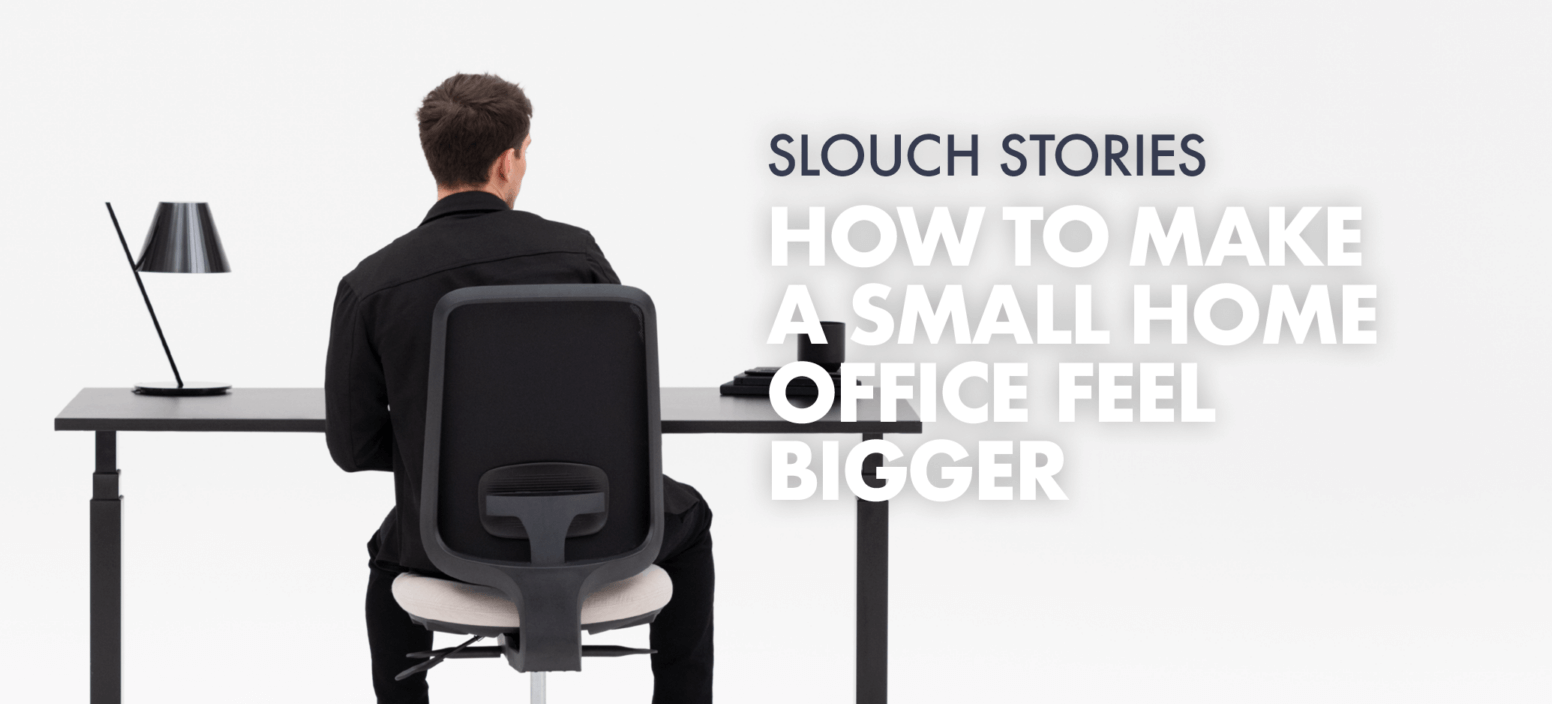
Working from home has truly changed how millions of people go about their working day. Now, more than a quarter of working adults in the UK have a hybrid working setup, where at least some of their time is spent at home, which is a huge jump from the pre-Covid rate of just under 5%.
While it’s given many people freedom and flexibility to work around their lives, some people still struggle to adapt their home to an office. When the dining table has no room for dinner and the mental line between work and play starts to blur, working from home becomes less attractive and more unorganised chaos.
Some have the luxury of having a large home office, set up with the best desk, the best chair (from Slouch, of course) and all the storage and organisation you can dream of. However, for most, your home office might be the box room or a small corner of the spare bedroom.
The question is, how can you make these spaces look bigger and become more organised so your working day runs a little more smoothly? That’s exactly what we aim to answer in this guide. We’ve come up with 10 ways you can make your home office feel bigger and more spacious.
1. Paint your home office a fun colour
Colour is everything when it comes to creating illusions. It can be used to zone certain spaces, draw the eye to a particular area or make a room feel bigger and lighter. We’ve previously written a guide to the best colours for your home office, as well as how to choose your colour.
Any shades that brighten and lift a space will make your home office feel bigger and more inviting, so you could consider lighter and cooler tones, including soft blues, sages, and off-whites. If you aren’t ready to commit to an entire room of colour, then think about painted sections, including an alcove or just behind your desk to help zone the space.
2. Make the room as bright as possible
The right lighting can make or break your home office, and it’ll take a space from a small, dark crevasse to one that feels bright and open. The real key is to layer your lighting instead of relying on one overhead bulb. You could have a desk lamp as task lighting and a floor lamp to create an ambient glow, switching between white bulbs and warm-white bulbs depending on the feel you want to create. Warm white tends to feel a little cosier, while bright white mimics natural daylight a bit more.
3. Use pattern and design to draw the eye in
Just like colour, pattern and design can be used in so many ways to trick the eye into thinking there’s more space than there is. A striped rug can be used to make a narrow room feel wider, or a feature wallpaper can add depth to a room that doesn’t really have any. Even artwork that draws the eye upwards can make the ceilings feel higher than they are.
If you have a small home office, these tricks can be used to make it appear bigger without actually having to rearrange your walls. Artwork above your desk can draw the eye to the space, making it appear larger than it is. You might even consider striped wallpaper that makes your ceilings feel taller.
You need to strike the right balance here, though. Too much pattern and the space might start to feel a bit cluttered, so keep the rest of the room simple and let your one statement piece do the talking.
4. Use mirrors to reflect light
It’s the oldest trick in the book but it works, which is why it’ll never get old. A mirror that’s put in just the right place will bounce natural light around the room and create the illusion of depth, effectively doubling your space (at least visually).
You should place your mirror opposite or near a window so it reflects as much daylight as possible (and the bigger the mirror, the better). If floor space allows, a tall leaning mirror can make a low-ceilinged nook feel much taller than it is. Even a small cluster of mirrors on one wall can do the job if you don’t have room for one large piece, and a mirrored cabinet door or wardrobe front gives you the same effect while doubling up as storage.
5. Get rid of clutter with clever storage
An organised space is a bigger space, so the less clutter and mess you have, the more space you have (yes, it’s really that simple).
You should get rid of any items you don’t need (we’ll come onto that in more detail shortly), and maximise your storage solutions, whether that’s a cupboard, shelving or desk drawers. Tidiness might not come naturally, so you can read our guide to keeping your office clutter-free in the long term.
Our guide to small office storage ideas might help you out a bit, too.
6. Consider vertical storage
Floor space is precious in a small home office, and the chances are your desk and chair take up all the space you have. But there’s somewhere else you can store things, an underused part of every room. The walls.
Floating shelves, wall-mounted filing racks and tall, narrow bookcases all make use of space that would otherwise be wasted, without eating into your walkway. It also draws the eye up towards the ceiling, which has the added bonus of making the whole room feel taller. Pegboards and grid panels are a great option too, since you can rearrange hooks and shelves as your needs change, rather than being stuck with fixed storage.
7. Get rid of any unused items
Before you buy a single new storage solution, have a proper clear-out. It’s tempting to hold onto old notebooks, outdated tech and paperwork “just in case”, but nine times out of ten, it’s just taking up room you don’t have to spare.
Take each item and ask yourself when was the last time you used it. If it was longer than 12 months ago, or you can’t even remember, get rid.
Equally, we’d suggest that you bin, shred or recycle any paperwork or documents that aren’t needed. Most things can (and should) be stored online on a cloud or backup system, so you don’t need endless filing cabinets full of old paperwork.
8. Be creative with your furniture layout
If you’re feeling like your home office is cramped or the space isn’t working for you, it might not be the furniture itself that’s the problem. It might be where you’ve put it.
Have a playabout with some different furniture arrangements, maybe angling a desk into a corner rather than pushing it flat against a wall or swapping a bulky office chair for something more streamlined, like one of our ergonomic office chairs.
You can free up space without having to sacrifice comfort, and that will make the space feel larger but also more practical. If your office shares a room with something else, like a spare bed or a sofa, try to visually separate the two areas with a rug or a piece of furniture rather than a solid divider, which will only make the room feel chopped up and smaller.
9. Hide all those cables
A home office will inevitably have a lot of cables. It’s an occupational hazard and one that can’t really be avoided. What you can do, though, is be clever about how you set up your cables so that they’re hardly visible.
Cable clips and trunking can be fixed along the back or underside of your desk to keep everything bundled together and out of sight. Your desk might even have clever built-in cable management (hello, Slouch desks 👋) so it takes the guesswork out entirely.
If your small office space doesn’t have many plug sockets, you can use a small under-desk power extension to keep everything in one place rather than trailing leads across the floor.
A cable box or basket is another easy win. Simply feed the excess length of your extension lead and any chargers into it, and tuck it out of sight under the desk. It’s a small change, but a tidy set of cables makes a space feel instantly calmer and less cramped.
10. Use all the space you have
We guarantee there are some areas of your home office that aren’t utilised well at all. It might be a bookshelf that only houses five books and the rest of the space is a dumping ground. You might have room under your desk for drawers or some storage, but instead it’s wasted.
Even small adjustments, like turning a desk ninety degrees or swapping which side storage sits on, can completely change how a room feels to move around in, so don’t be afraid to try a few layouts before settling on one.
You definitely don’t need an entire spare room or a huge budget to make your home office feel functional and big enough. We hope we’ve inspired you to make some changes to your small home office to make it work a bit better for you, and happy experimenting!
