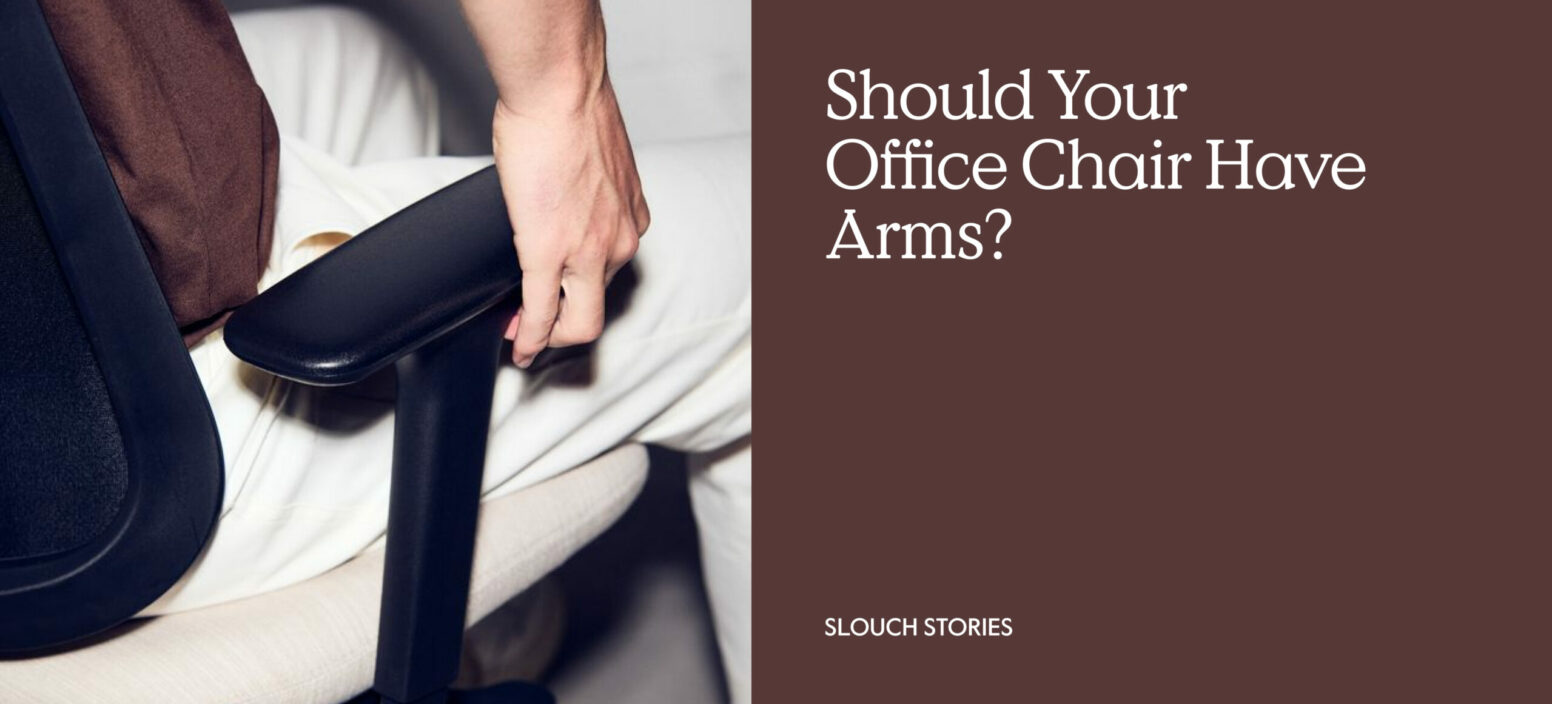
When you picture the ideal office chair, armrests probably aren’t the first thing that comes to mind. You’re more likely thinking about lumbar support, seat height, or how it looks at your desk. But whether your chair has arms (and how they’re set up) can have a surprisingly big impact on how you feel at the end of a long working day.
Here’s why armrests can be useful
Armrests do actually serve a practical purpose, beyond just being somewhere to rest your elbows.
When you prop your arms on an armrest, you’re adding support and taking excess weight off your shoulders. This in turn prevents the hunching and tightening that typically builds up when you spend hours a day at a desk. They can also help your upper body to become more balanced, reducing the load on your lower back.
During non-typing tasks, like reading, thinking or being on a call, they allow your arms to relax naturally rather than dangle unsupported. Plus, for anyone with knee or hip issues, armrests can make it easier for you to stand up and sit down.
But here’s why you might not need them
While there are some clear benefits, armrests aren’t necessarily always beneficial. Sometimes it feels like you get in a fight with them when you try to pull your chair closer to your desk, and the added space when this happens means you reach forward to type or use the mouse. This can actually be worse for your posture than having no armrests at all.
They can also get in the way if your work involves a lot of reaching or moving around, annoying you rather than being genuinely useful.
People with a narrower frame sometimes find that fixed-width armrests sit too far apart to offer any real support, causing them to lean awkwardly instead.
The key point is that a poorly positioned armrest is worse than no armrest. If you can’t adjust them to suit your body, it’s often better to remove them or choose a chair without. Many chairs have adjustable armrests so you can move them up or down as required, a great feature for any ergonomic office chair.
With or without?
For most office workers spending six or more hours at a desk, armrests are worth having, provided the chair allows for proper adjustment. They’re especially valuable if you experience regular shoulder or neck tension, type for long stretches throughout the day, or have a history of RSI or joint problems.
How to adjust your armrests correctly
When your office chair does have armrests, they must be set to the right height for you. But how do you know what the right height is?
Your arms should rest at a 90-degree angle at the elbow, and your shoulders should be relaxed rather than raised too high or dropped too low. If your chair has adjustable-width arms, bring them close enough that your arms rest naturally by your sides without splaying outward.
Some chairs also allow the armrests to tilt or slide forward, so if yours does this, position them so your forearms are supported when your hands are near the keyboard, and not stretched out in front of it.
Here’s a simple test you can try: if your shoulders creep up towards your ears, your armrests are too high. If you’re slumping sideways to reach them, they’re too wide or too low. Knowing the right height is all about the shoulder position.
So, should office chairs have arms? For most desk workers, yes, but only if they can be properly adjusted to your body. They’re the kind of thing you don’t notice if they’re positioned properly but you definitely notice if they’re wrong.
At Slouch, you can choose an office chair that comes with or without arms, depending on your preference. As our chairs are completely ergonomic and built with your comfort in mind, the soft-touch arms are height adjustable, but you can also adjust the pads forwards and backwards to get that perfect fit.
