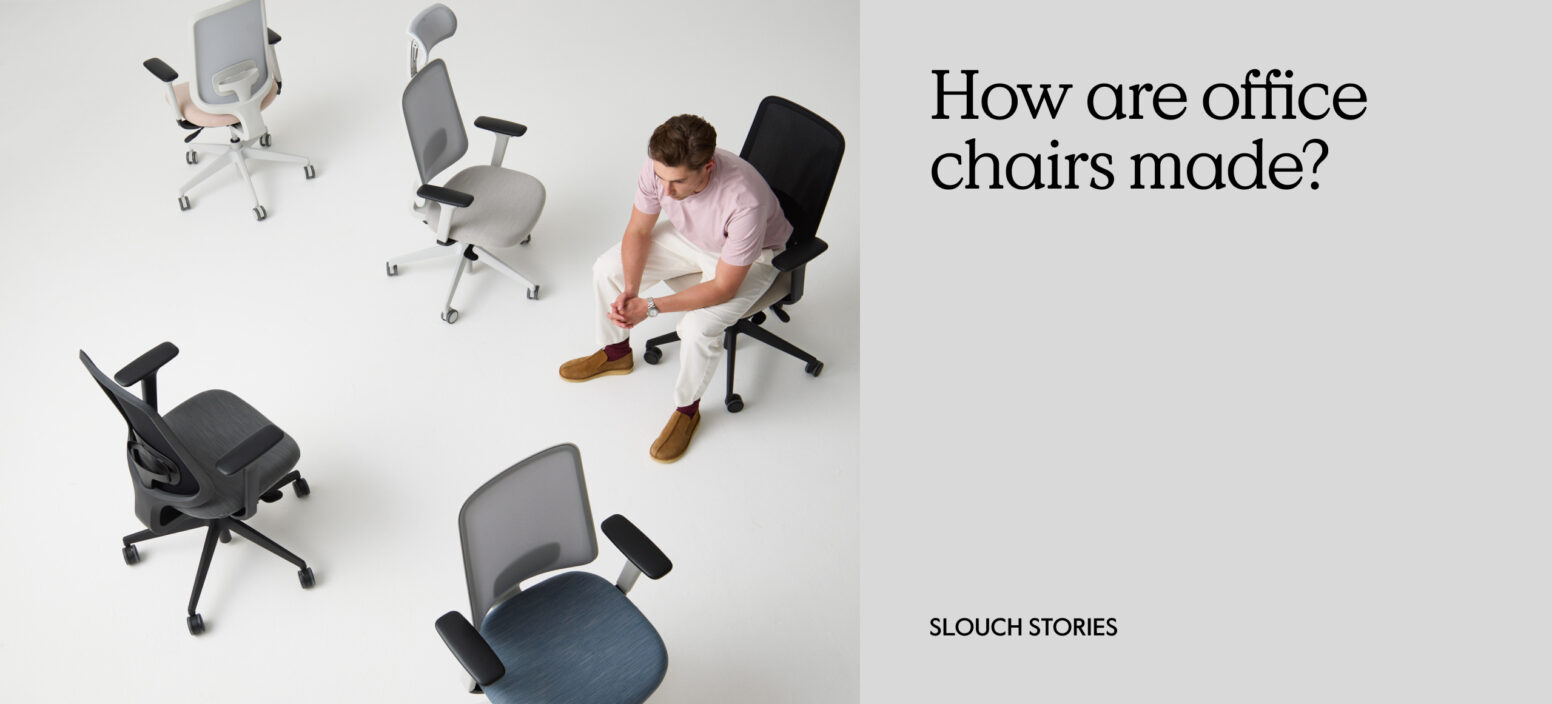
You spend a lot of time in your office chair, but you might not have spent time wondering how it came to be. Behind every well-designed, supportive office chair is a huge team of designers, engineers and manufacturers that created it.
Below, we give an overview of how office chairs are made, as well as how we design and build our Slouch office chairs.
How office chairs are made (the general process)
Step 1: Designing
Before a chair can be made, it needs to be designed for practicality, functionality and aesthetics. A team of designers and engineers work together to decide how the chair adjusts to different bodies and in what ways the chair can be adjusted, including seat height and depth, seat tilt, arm rest height and lumbar height.
Once these things are decided on, computer-based structural analysis is used to test how the chair would perform on a day-to-day basis, and 3D prototypes are created that can be tested and tweaked before a complete chair is made.
Step 2: The materials
There are lots of different materials used to create one office chair, including plastics, metals, foam and mesh.
Plastics are more commonly used for the chair base and to create the seat and back rest frame. In some instances, nylon is reinforced with glass fibre to create a lightweight and sturdy chair frame and base. Aluminium is the most common kind of metal used in an office chair, and is applied to the base and the arms, but it’s quite an expensive material. Foams and fabrics are then used on the outer frame and for the seat base for maximum comfort.
Each material will be carefully thought about by the chair designers to ensure maximum comfort, increased longevity and a suitable price point.
Step 3: Manufacturing
Once the office chair designers and engineers have decided on the chair’s features and materials, a prototype is created that can be tested. Each material that’s used is manufactured in a slightly different way, which is why we’ve broken the process into individual components:
- The chair base
Office chair bases are usually made from either aluminium or nylon. In the case of aluminium, the product is subjected to very high temperatures that turn the metal into a liquid. This molten aluminium is then injected into a mould and allowed to cool and set. Once it’s set, it can be removed from the mould and polished, brushed and powder coated.
For a plastic or nylon chair base, the process is similar. The plastic components are heated until they melt and are then injected into a mould and left to cool down. Once the plastic has cooled and set, it can be removed with no need for polishing or powder coating.
- The foam seat
Moulded foam, as the name suggests, is made in a mould rather than being cut from a block, which helps the seat to keep its shape for much longer, with no sagging or dipping that eventually leads to a lack of support.
- The fabric (mesh or otherwise)
The final materials are cut to shape, and these are generally used to cover the seat foam and also cover the frame of the back rest. Mesh is a common material to use, as it’s so breathable.
- The gas lift
An essential part of an office chair, the gas lift holds your chair at a set height. It’s essentially a sealed tube that has a piston inside it, and the tube is filled with compressed nitrogen. The main parts of the gas lift are the cylinder (this is the outer casing), the piston (the part that moves up and down inside the cylinder) and the seals/valves (which stop the nitrogen from leaking out).
Step 5: Assembly
All of the manufactured parts can be put together to create an office chair. Some manufacturers (including Slouch), only semi assemble the chair so that it can be shipped and then assembly is completed by the user. For instance, we wrap the fabric around the seat foam and attach it to the frame, and we build the gas lift, but the user has to lock some parts together, such as the gas lift to the 5-star base.
Step 6: Testing
Before any office chair is sent out, it needs to be tested for stability and durability, particularly according to the recognised European standard EN 1335.
How a Slouch office chair is made
At Slouch, we’ve been designing and manufacturing quality office chairs for more than 45 years. Our process has slightly improved over this time to ensure efficiency but also quality, so here’s what you can expect when you order a Slouch office chair:
First, they’re designed and engineered in-house
Our expert and knowledgeable team of designers shape how our chairs look and feel, working alongside engineers who make sure they stand the test of time. From structural analysis to 3D printing, our engineers design, test and refine every aspect of the chair.
Every material and component has been carefully thought about, from the moulded seat foam that won’t sag over time to the breathable 3D spacer mesh backrest. Our 65mm chair castors are designed for easy movement, while our lightweight nylon base is strong and affordable, which is one of the reasons why our chairs can be so competitively priced.
Then, they’re manufactured here in the UK
Sustainability is at the core of what we do, so we don’t import chairs from other countries. Our chairs are made here in the UK to reduce environmental impact.
They’re tested again and again
We’re sticklers for testing. Our Task One meets EN 1335-2 and ANSI/BIFMA X5.1 requirements for durability and stability, is tested up to a user weight of 125kg, and has seat fabric tested to BS 5852. We think about every stress and strain a chair might meet over a long working life, and then some.
We believe that the materials, the moulding and the testing all affect how comfortable your office chair feels, how well it supports you and how long it will last. If you’re ready to feel the difference, invest in one of our ergonomic office chairs.