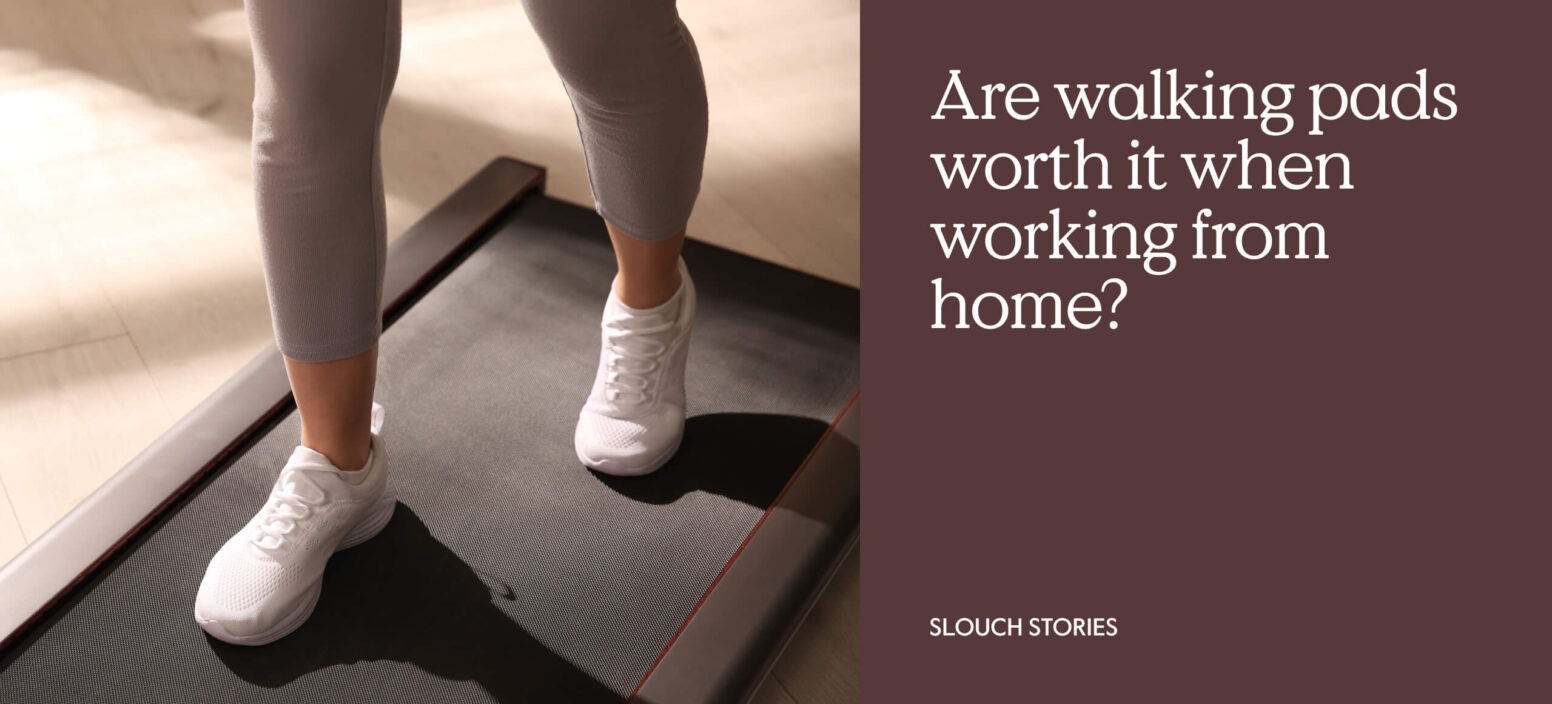
So you’ve seen a ton of people using a walking pad on your TikTok feed and now you’re here to find out whether they’re actually worth the purchase.
For some, they’re a home-office favourite and something they could no longer do without. For others, the pad sits under their sofa for months waiting for the day it gets used.
That’s why our guide covers everything you need to know about walking pads, including their pros and cons, who can most benefit from one and how an office chair compares. We’ve even included a handy ‘check before you buy’ checklist that should help you to pick the right product for you. So let’s get into it.
Contents
- What are the benefits of a walking pad?
- What are the drawbacks of a walking pad?
- How does a walking pad compare to an office chair?
- Who can benefit most from a walking pad?
- What to check before you buy: A checklist
- FAQs
- Slouch’s verdict
What are the benefits of a walking pad?
- It helps to break up long periods of sitting
Most people with desk jobs sit down for six to eight hours a day. The NHS estimates it to be about seven hours for the average adult, increasing to 10 hours for those over the age of 65. So with all those hours of sitting, how can you get more active while remaining productive? The answer could be a walking pad.
You can get your steps in while writing up a report, attending an online meeting or reading through an important document. Even short sessions, say 10 minutes at a time a few times a day, will really improve your daily step count.
- It encourages low-impact movement
Walking is one of the easiest ways to move your body, particularly if you have health conditions that make other forms of exercise difficult. The NHS considers walking a ‘moderate aerobic activity’, which also includes riding a bike, dancing, pushing a lawnmower and rollerblading. All of these things will raise your heart rate and make you breathe faster and they recommend you do around 150 minutes a week.
This is likely going to be easier to achieve with an under-desk walking pad, particularly if you work long hours.
- It’s always available, and the weather doesn’t matter
There are lots of reasons why fitting in your daily exercise can be difficult. It’s hammering it down outside, the evenings are too dark to go out for a walk, or you’ve had back-to-back meetings all day. With a walking pad, it really doesn’t matter how bad the weather is or how busy you are. It’s always available, even just for 10 minutes during your lunch break.
- It’s compact and quieter than a treadmill
A walking pad is absolutely not the same as a full treadmill. They’re significantly smaller, they fold away or stand upright when not in use, and they’re much lighter for manoeuvrability. Most weigh between 17 to 20kg and take up less space than a bulky running machine. They also run quietly, so the sound won’t interrupt your morning meeting.
- They’re cheaper than a gym membership or a treadmill
A walking pad will likely work out cheaper over time than a gym membership, particularly as some budget models can be picked up for £100, the equivalent of 2.064 months at a gym (based on the average membership of £48.45). Even mid-range models can be picked up for less than £250, while a budget treadmill can cost anywhere from £400 to £600.
What are the drawbacks of a walking pad?
- They could make it harder to type
One particular analysis, which reviewed the various studies on cycle and treadmill desks, found that exercising while you work can reduce your typing speed, although the analysis notes that it’s “likely not due to a decrease in cognitive function”. Instead, it’s more likely that it takes time to adjust to moving and typing at the same time.
For this reason, most people prefer to use a walking pad for certain tasks. It might not be beneficial to use it when writing up an important, in-depth document but could be useful during calls or admin tasks.
- You need the right desk
If you have a standard desk, you need to think about how it can be raised to accommodate your new standing position. This means you either need to invest in a height-adjustable desk or you need to find a way to raise your laptop/screen high enough so you can work and type on it. As a guide, the HSE recommends that you keep your keyboard just below elbow height.
- It’s not a full workout
Walking pads are a really great way of getting some extra steps in each week, but they aren’t comparable to a full workout, which the NHS recommends you should be doing for around 75 minutes a week. This could be in the form of running, swimming, sports, gymnastics, etc.
- They aren’t completely silent
In our pros list, we explained that their noise level is minimal, but the motor does still make a noise and this can carry through to floors below, so it’s worth thinking about if you live in a flat. You’ll also need to protect your floors against scratches with a mat that’s suitable for the walking pad. This can help to dim some of the noise to floors below, too.
- You need to store it somewhere
Many walking pads are extremely compact and will slot underneath sofas or fit into a cupboard, but you will need to find a suitable place to store it when you’re not using it. If you’re short on space, it’s worth considering before you buy.
How does a walking pad compare to an office chair?
It’s really hard to compare these two things, as they do very different jobs and we recommend that you use a quality, ergonomic office chair alongside a walking pad for maximum benefit. However, you can find a general comparison below.
| Walking pad | Office chair | |
| Main job | Gets you moving while you work | Supports your body in a healthy seated position for long stretches of time |
| Posture and support | None. It’s a walking surface, so you rely on your desk and screen setup for posture | Provides the support your body needs while sat down, including back and arm support |
| Movement and activity | Adds light to moderate activity while you work to hit your weekly target | Helps you to shift comfortably, but doesn’t replace getting up and moving |
| Typung and mouse work | Potentially makes it trickier to type and use a mouse | Makes it easy to type and use your mouse for efficiency |
| Calls, emails and reading | Ideal for these kinds of lighter tasks | Works for these tasks but means you’re sat down all day |
| Space and noise | Needs floor space, a storage spot and a mat | Has a small footprint and doesn’t make noise |
| Cost and upkeep | You can purchase a good one for around £200. Some belt maintenance might be required | You can purchase a quality office chair for £300 to £400, with a longer lifespan than a walking pad |
We wouldn’t view it as a choice between a walking pad or a chair. Instead, these two things work really well in tandem to ensure your body isn’t feeling the effects of sitting down for hours every day.
Why you still need a quality ergonomic office chair
It’s probably not an option for you to spend every working hour on a walking pad, which is why you still need an office chair. If you’re looking for a new chair, you should ensure that it’s ergonomic, designed so it’s completely adjustable so it supports your body in the best way. This means adjustable seat height, seat depth, seat and back rest tilt, arm rests and lumbar support. Slouch’s ergonomic office chairs do all of this and more for the most comfortable working day of your life.
Who can benefit most from a walking pad?
A walking pad is likely worth it if:
- You work at a desk or from home and sit for the majority of the day
- Your day is filled up with video calls or meetings that allow you to walk at the same time
- You find it hard to get outdoors because of the weather or your schedule
- You don’t have space for a full-size treadmill
- You want a low-impact way to move for regular intervals throughout the day.
If you have a health condition, an injury or problems with balance, it’s sensible to speak to your GP before starting something new.
What to check before you buy: A checklist
- Speed range
- Belt size (it should be wide enough for you to walk comfortably, at least 45cm)
- Weight capacity
- Noise level
- The size, weight and storage
- Floor protection
- How it’s controlled
- Its safety features
- Whether it has a warranty
- Your desk height
FAQs
Do walking pads count as exercise?
Yes, they do, but only if the walking pace means your heart rate is up and you’re getting warmer. If this isn’t the case, then it’s not considered moderate enough exercise by the NHS.
Should I get a walking pad or a standing desk?
Both of these things solve different problems. A standing desk is great for changing your posture and improving blood flow while you work, whereas a walking pad helps to add in some movement. You’ll probably need a height-adjustable desk to use a walking pad comfortably anyway, so the two work well together.
Can you use a walking pad all day?
You can if you want to, but you don’t really need to. The idea of it is to break up long periods of sitting, not to replace sitting altogether. You can start with short sessions and then build them up gradually.
Slouch’s verdict
So, are walking pads worth it? For most desk-based workers, yes they are, particularly when used as part of your setup rather than all of it. A pad is a great way to break up the day with some gentle movement, but it can’t support you when you sit, and it could make typing and mouse work trickier.
We’d recommend the ultimate combination: a walking pad for movement, a height-adjustable desk so you can sit or stand, and a fully adjustable office chair that supports you while you sit. View our complete collection of chairs and office desks.